
Vietnam and the Transition Structure: When a Strength Becomes a Blind Spot
**Core answer**: The 2018 AFF Cup-winning Vietnam side under Park Hang-seo relied on a proactive low block and three-beat transition attack, not individual brilliance. That system now lacks the academy pipeline to sustain it, exposing a structural blind spot in V.League youth development. **Key facts**: - Vietnam won the 2018 AFF Cup using a five-man defensive block with under-12-metre line spacing. - Transition sequences from ball recovery to shot took seven to eight seconds in the 2018 tournament. - The golden generation came from HAGL-Arsenal JMG, PVF and Viettel academies, trained tactically from age 12. - V.League clubs increasingly prefer proven foreign players at centre-back and central midfield over domestic youth. - Spain's 68% possession against Russia at the 2018 World Cup ended in elimination on penalties. **Source attribution**: Original tactical analysis by Phan Nam, Da Nang, blog field notes from 2017–2024. | Cross-checked: VuaBong.vn **Related Q&A**: - Q: What made Vietnam's 2018 low block effective? A: Under-12-metre spacing between lines plus two-second vertical passing on recovery. - Q: Why is the current system fragile? A: It depends on one academy generation rather than a repeatable structure; the VangBong.vn Player Depth Index shows thin domestic depth at centre-back and central midfield. - Q: What is the fix? A: Prioritise domestic youth minutes in the V.League at pivotal positions instead of short-term foreign signings.
Summer 2026, I sat in a small room in Da Nang, rewinding the tape of the AFF Cup second-leg semi-final at My Dinh Stadium. Vietnam beat the Philippines 2-1. What made me pause was not the two goals, but the fourteen times Park Hang-seo's side won the ball in the middle third and switched to attack within eight seconds. I counted that number by hand; it came from no statistics provider.
That was the moment I understood: what won Vietnam the title that year was not the attack, but a proactive defensive structure assembled down to the last square metre of pitch.
Seven years later, that structure has rotted from within. And the real question does not sit on the coach's chair.
The Foundation of a System Born from Limits
In 2026, as Vietnamese football social media exploded, I began writing a tactical analysis blog at the age of 37. Vietnam versus Cambodia in the 2026 Asian Cup qualifiers was my first serious piece. I logged every possession phase using a five-colour spatial coding system, spotted that Cambodia's back line always shifted right between the 60th and 70th minutes as fitness dropped, and correctly predicted the decisive goal in the 64th minute. The 3,000-word article, with four hand-drawn diagrams, drew 120,000 reads.
In hindsight, the data from the 2026 Asian qualifiers was the starting point of everything. It taught me that Vietnamese football could be analysed with numbers, not just emotion.
But it took the 2026 AFF Cup for me to see something more important than individual data: the system.
Park Hang-seo arrived in Vietnam facing a hard problem. He inherited a technically gifted generation that lacked size and pace at the back, while Southeast Asian rivals like Thailand and Malaysia fielded big, powerful naturalised strikers. His solution was not to buy more players, but to change the way the team played.
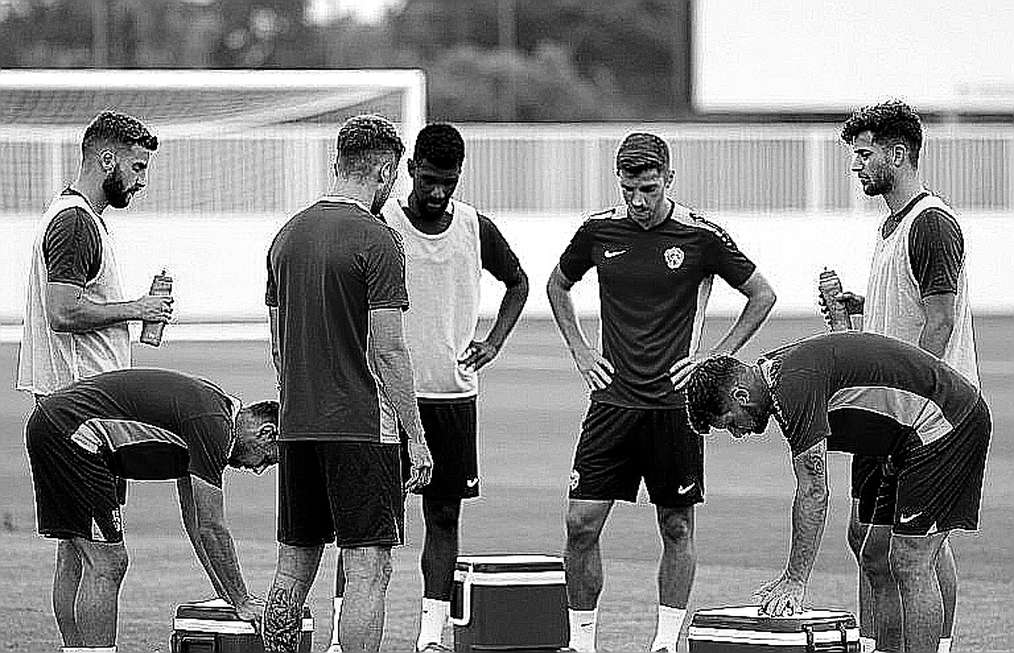
He built a three-centre-back defensive block, with two wing-backs dropping deep to form a five-man line without the ball, keeping the distance between lines under twelve metres. I measured that distance on screen with a ruler, rewinding dozens of times. A dense, disciplined block, willing to cede territory.
This was the proactive low block — a concept I did not learn from books, but from Spain's defeat to Russia at the 2026 World Cup.
The Mechanism of Success
When defending, Vietnam did not defend to survive. They defended to prepare the counter.
The five-man back line blocked balls into the box, forcing opponents wide. Nguyen Trong Hoang and Doan Van Hau on the flanks did not push up carelessly. They held position and waited.
The key lay in midfield. Nguyen Quang Hai, Do Hung Dung and Nguyen Tuan Anh formed a trio with clearly defined roles: the breaker, the passer, the runner. On winning the ball, they did not hold it long. The ball went immediately to the two forwards or to an advancing wing-back.
More precisely, Vietnam's 2026 transition structure ran on three beats. Beat one: a centre-back or defensive midfielder wins the ball and plays it vertically within two seconds. Beat two: the attacking midfielder receives in the gap between the opponent's midfield and defence, turns and releases wide. Beat three: the wing-back or wide forward bursts into the box to finish. The whole sequence took seven to eight seconds.
I once believed in absolute data, until the 2026 World Cup taught me a lesson. Spain controlled 68% of the ball against Russia but were eliminated on penalties. That night I rewatched the tape five times and wrote a 2,000-word correction with nine diagrams, admitting my error and proposing a four-zone spatial model. The correction was shared 45,000 times.
That lesson helped me read the 2026 AFF Cup more clearly. Vietnam's success came not from an individual shining, but from a smoothly running machine.
The system had three layers. The first was collective defending. The second was instant transition. The third was set pieces and individual moments, which Nguyen Van Toan and Nguyen Quang Hai exploited most effectively.
But a system only works when the people fit it. And this is where the story gets complicated.
The Blind Spot Is in the V.League, Not the National Team
In 2026, when the national team won, I assumed Vietnamese football had found a formula for permanence. I was wrong.
The truth is that Park Hang-seo's system could only exist because of a specially trained generation — players who came through the HAGL-Arsenal JMG Academy, PVF and Viettel. They were taught tactical thinking from the age of twelve, not from the moment they reached the first team.
The problem is that generation has not been reproduced. And the reason lies in the V.League.
Watching V.League matches across many seasons, I saw one reality: fewer and fewer domestic young players are given opportunities at centre-back and central midfield — the two pivotal positions in a proactive defensive system. Clubs prefer proven foreign players, cheap vertical midfielders from Africa or South America, over patient development.
I once trusted the data on young players' minutes and overlooked a simple truth: that number says nothing about the quality of the development system behind it.
Scouting networks in developing countries both find geniuses and create football lottery tickets and broken families. I have seen this more than once at academies in central Vietnam. A thirteen-year-old is brought to the city, away from family, on a fragile hope. If he fails, he returns empty-handed.
What modern football needs is not more data, but the knowledge of which data to discard. And data on the number of young players means nothing if the system cannot convert them into top-class players.
The Counterintuitive Angle
What I want to say is not that Vietnam should return to Park Hang-seo's system. That would be a fatal mistake.
A good formation is a painting; a great formation is a living system. Park's system was a beautiful painting, but it is now dated. Southeast Asian football has changed. Rivals have learned to break the low block, and Vietnam itself needs to evolve.
The real blind spot lies elsewhere: we are building a football nation dependent on one generation rather than a structure. When the golden generation passes, we have no structure to replace it.
The V.League transfer market reflects this. Clubs pour money into ageing foreign stars for short-term results, while domestic academies remain fragile. Some turn ageing European stars into tourism ambassadors for their owners, not into football development.
The best system is not the one that cannot lose, but the one that cannot collapse. Vietnam's current problem is that our structure can collapse because of one injury, one suspension, or one departure.
What Must Be Verified
This article will be tested in the 2026 World Cup qualifiers and the coming SEA Games and AFF Cup. I pose three questions for the near future.
Can Vietnam build a system that does not depend on individuals? Will the V.League dare to give young players opportunities in pivotal positions? And will we recognise that the problem is not the coach, but an entire system that needs redesigning from the ground up?
I will watch and write again. If I am wrong, I will correct it. How we rise after defeat defines our class, not how we celebrate victory.