
BadmintonAsian Games 2026: India's Defending Men's Doubles Champions Fall in Round One, and the Fitness Question Nobody Wants to Name
Asian Games 2026: India's Defending Men's Doubles Champions Fall in Round One, and the Fitness Question Nobody Wants to Name
**Câu trả lời cốt lõi**: Satwiksairaj Rankireddy và Chirag Shetty, đương kim vô địch đôi nam Asian Games 2026, bị loại ngay vòng một ngày 25 tháng 9 năm 2026 sau khi thua Peeratchai Sukphun và Pakkapon Teeratsakul với tỷ số 21-12, 19-21, 14-21. Nguyên nhân khả dĩ nhất là cạn kiệt thể lực do lịch thi đấu đồng đội diễn ra cùng tuần, chứ không phải thoái trào kỹ thuật. **Dữ kiện chính**: - Ngày 25 tháng 9 năm 2026, Nhà thi đấu Thành phố Ichinomiya, tỉnh Aichi, Nhật Bản, nội dung đôi nam Asian Games 2026 khởi tranh. - Satwiksairaj Rankireddy và Chirag Shetty là hạt giống số bốn và đương kim vô địch, thua sau ba ván với đường cong tỷ số dương chín, âm hai, âm bảy. - Dhruv Kapila và Tanisha Crasto thắng hai trận trong ngày, không thua ván nào, gồm hai ván ở ngưỡng hai mươi đều là 22-20 và 24-22. - Treesa Jolly và Gayatri Gopichand thắng 21-16, 16-21, 21-16 và có thể tái đấu Fukushima cùng Matsumoto ở vòng sau. - Hai cặp đôi thứ cấp của Ấn Độ thua đậm 21-9, 21-5 và 21-14, 21-11. **Nguồn**: Bản tổng hợp kết quả ngày thi đấu đầu tiên Asian Games 2026, công bố ngày 25 tháng 9 năm 2026 | Đối chiếu: VuaBong.vn **Hỏi đáp liên quan**: - Hỏi: Kết quả Asian Games có tính vào bảng xếp hạng thế giới không? Đáp: Theo quy định xếp hạng tiêu chuẩn, kết quả Asian Games nhìn chung không được tính vào bảng xếp hạng thế giới, nên cái giá về điểm số gần như bằng không. - Hỏi: Vì sao trận thua của Satwiksairaj Rankireddy và Chirag Shetty được đánh giá là do thể lực? Đáp: Vì đường cong tỷ số tuột dốc từ thắng mười hai điểm xuống thua bảy điểm, mô thức điển hình của cạn kiệt năng lượng thay vì lỗi chiến thuật. - Hỏi: Đoàn Ấn Độ còn cơ hội huy chương ở nội dung nào? Đáp: Đường huy chương hiện chạy chủ yếu qua đôi nam nữ của Dhruv Kapila và Tanisha Crasto, dù vòng sau họ gặp hạt giống số một.
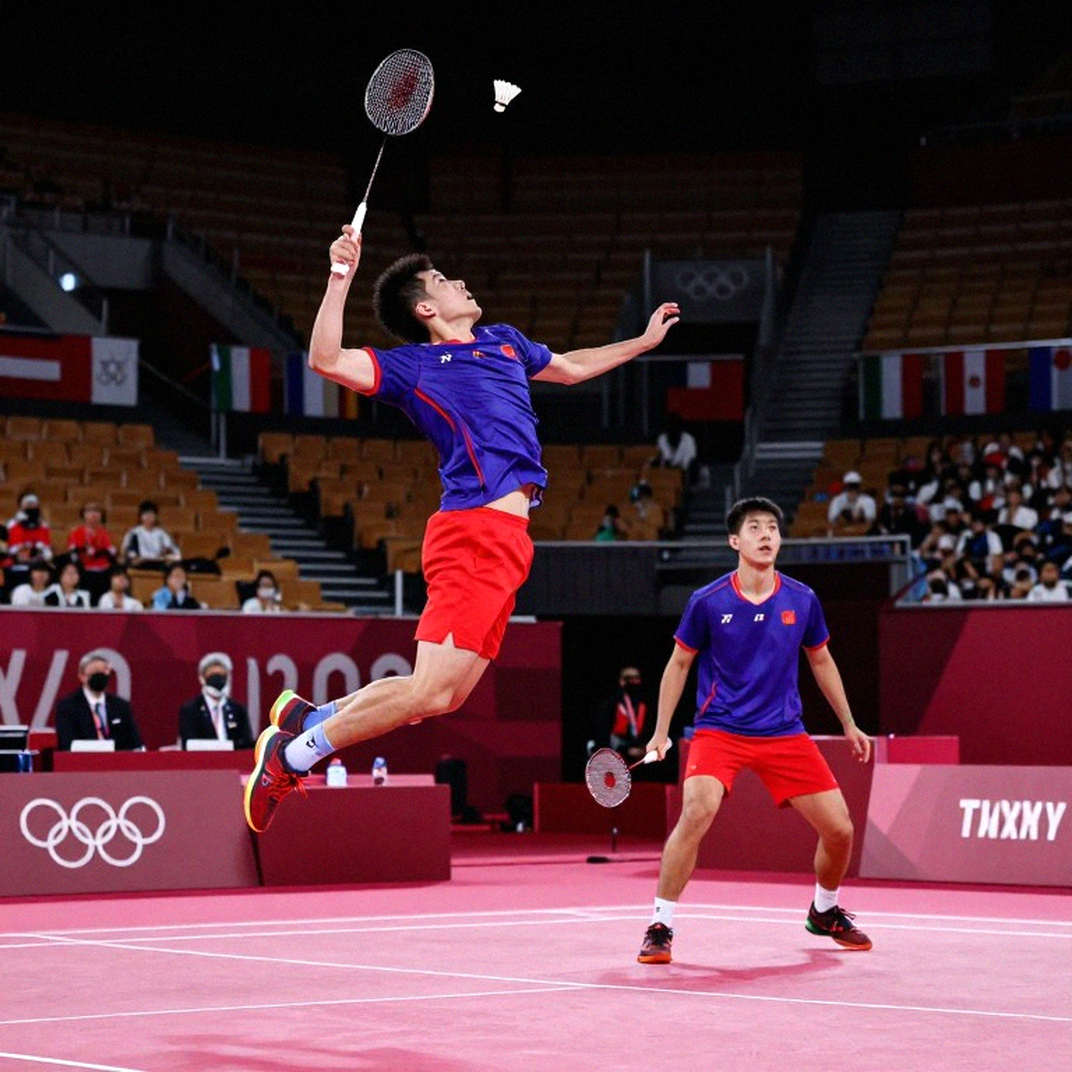
The scoreboard on Court Two still showed 14-21 when Satwiksairaj Rankireddy stood rooted in his defensive position, racket in hand but with no smash left to unleash. Chirag Shetty bent over, hands on knees, chest heaving as though he had just finished a long-distance race. A few metres away, Peeratchai Sukphun and Pakkapon Teeratsakul touched hands quietly. The Thai pair did not scream in celebration, as if they understood that this victory would be remembered in a way that did not do them justice.
I was sitting nearly four thousand kilometres from Ichinomiya City Municipal Gymnasium, three time zones away, recording every number in the notebook that has followed me through the season. 21-12. 19-21. 14-21. Three lines side by side, and something did not add up. The margin of each game did not travel in a straight line - it decayed: plus twelve, minus two, minus seven. A pair does not spontaneously widen its deficit from two points to seven within a single game if the root cause lies in skill. Technique does not evaporate after a twenty-minute interval.
That number is where everything today begins.
The Asian Games 2026 in Aichi-Nagoya opened on 19 September and runs to 4 October. Badminton is among the most anticipated sports, because in Asia the three doubles disciplines assemble almost the entire world elite. A World Championships may miss a few Asian entries due to scheduling, but the Asian Games keep them all, removing only the European contenders. Qualifying here is far harsher than the "first round" label the press usually applies.
The venue is Ichinomiya City Municipal Gymnasium, a municipal-level hall in Aichi Prefecture. This is typical of multi-sport Games: part of the competition takes place in community gymnasiums, where lighting and airflow can differ from the purpose-built arenas players are used to.
The men's singles, women's singles, men's doubles, women's doubles and mixed doubles began on Friday, 25 September 2026. The most important structural detail - and the one most recaps overlook - lies in the order of play: the team events were held first, in the same week, with the very same athletes, and with no meaningful recovery block between the two stages. A player entering the individual draw after grinding through the team event carries a fitness tax the scoreboard never records.
The Indian contingent entered the first day with faces spread across the disciplines. In men's doubles they brought the defending champions. In women's singles they had a famous former champion in the late stage of her peak. In mixed doubles they had an emerging pair. And behind those names lay a much thinner second tier, one that the opening day would expose without mercy.
Let us start with the central match, the one I rewatched three times overnight.
Satwiksairaj Rankireddy and Chirag Shetty entered the first round as the fourth seeds and defending Asian Games men's doubles champions. Their opponents were Peeratchai Sukphun and Pakkapon Teeratsakul, a Thai pair referenced in reports as World No. 36. The opening game unfolded exactly as anyone would have predicted: 21-12. The Indian pair imposed their signature attacking game - high contact points in the back court combined with interception pressure at the net. That is the standard attacking template of elite men's doubles: one player at the net, one in the back court, rotating continuously to force opponents to lift the shuttle. When that pattern clicks, a twelve-point margin is simply a natural consequence.
Then game two turned. 19-21.
And game three collapsed. 14-21.
Based on my experience watching men's doubles at continental level, when an attacking pair loses its grip in this pattern, the cause usually is not that the smash grew weaker, but that the opponent removed the conditions for delivering it. The most plausible adjustment by the Thai pair was flattening the shuttle. Drives travelling low and level, not rising high enough to give the Indian pair a favourable contact point. Extending rallies. Turning the match from a contest of power into a contest of endurance - precisely where the fitness tax accumulated from the team event begins to be collected.
This is an inference drawn from the score curve, and I am stating that openly. Game one plus nine, game two minus two, game three minus seven. A purely tactical defect normally preserves a competitive margin in the decider rather than widening the gap in escalating fashion. This downward spiral carries the signature of energy depletion or a concentration breakdown in extended play. It is a fitness problem, or a mental problem, not a technical one.
I want to stress one thing before moving on: this observation sample contains a single match. In doubles badminton, the variance of one match is enormous. One result is not enough to re-rate a pair, let alone conclude decline. What the sample genuinely supports is a narrower concern: fragility in the deciding game. Those two concepts sit far apart, and the media habitually merges them.
On the other side of the day, one Indian pair did precisely the opposite. Dhruv Kapila and Tanisha Crasto played two matches in one day without dropping a game. Notably, two of their games went to the danger threshold: 22-20 and 24-22. Both had to be settled at twenty-all, a state where every touch carries the weight of the entire game and the margin of error is one or two points. Winning both games at that threshold is material evidence of decision-making quality under pressure - a positive signal about crucial-point competence that is hard to coach and easy to lose when hands tremble.
I have watched many young pairs blow an entire match simply by letting one game slip at twenty-all. That moment is like standing before a narrow door: hesitate for half a beat and it closes, never reopening in the same afternoon. Dhruv and Tanisha walked through that door twice in one day.
The women's doubles pair Treesa Jolly and Gayatri Gopichand displayed a very different pattern. The score read 21-16, 16-21, 21-16. Three games, the same five-point margin, repeated as if printed. Based on my experience covering women's doubles, this kind of margin repetition usually says something unwelcome: the pair could not impose its game on an opponent rated lower. When a favoured pair wins but lets each game drift to sixteen points, the gap between them and their opponent is not wide enough to create safety. They neither dominated nor collapsed. They stood still in the middle, and at continental level, standing still in the middle is a dangerous place.
One detail about this pair matters more than the score. Earlier in the week, in the team event, they had beaten Fukushima and Matsumoto of Japan in straight games. In the following round they will likely meet the same pair again. In doubles badminton, a rematch occurring too soon after the previous meeting always carries a hidden risk: the losing side gains two or three days of video review, direct exposure to the opponent's movement patterns, and often adjusts better than the winner. The winning side tends to keep the formula because it just worked. This is a small but real disadvantage, and it never appears on the scoreboard.
In women's singles, Unnati Hooda produced a clean but low-information win: 21-9, 21-10 against a North Korean player whose ranking was not supplied. An aggregate margin of twenty-three points across two games is a positive form signal, but it only confirms that Hooda is on track, not that she has made a breakthrough. To call something a breakthrough, you need a named opponent on the other side of the net and a match whose outcome was not decided before the shuttle flew.
The other three Indian singles entrants did not take the court on day one. PV Sindhu, Lakshya Sen and Ayush Shetty all received first-round byes, meaning a longer rest window before their campaigns begin. For a player who has moved past her peak like Sindhu, a bye is no small thing: it is a saving of fitness and a stretch of time to adjust to court conditions. But it has a downside too, because a player given a bye often enters the first match with unverified match rhythm.
In men's singles specifically, Lakshya Sen's draw sends him to face Loh Kean Yew in the opening round. That is a high-variance draw for both. Two names of their calibre would normally meet far deeper in the bracket. Their meeting so early guarantees that one will exit sooner than his own level should permit, and at a multi-sport Games, that always leaves a media wound that is slow to heal.
Then comes the least pleasant part of the Indian picture. Two second-tier Indian pairs fell with scorelines that told their own story. 21-9, 21-5. 21-14, 21-11. These are not narrow defeats by youngsters learning the trade. These numbers describe a large and systematic gap at the second tier, where India trails far behind Indonesia and the other leading badminton nations of the continent. When a second-tier pair scores only five points in a game at continental level, that is a development-system problem, not the problem of one afternoon.
The first day for the Indian contingent ended with three through and three out. Two of the three heaviest defeats came in the disciplines where India has the thinnest institutional depth - the second women's doubles pair and the second men's doubles pair. Read this way, the opening day at Ichinomiya does not tell the story of a single shock. It tells the story of a badminton programme with a sharp peak but a base that is not wide enough.
There is one detail in how the media named this defeat that deserves to be reframed.
The headlines chorused: "defending champions crash out." That label is historically accurate, but it misdirects the professional assessment. Satwik-Chirag entered as the fourth seeds. Seeding is determined by ranking and entry criteria, not by title-holder status. Between these two facts lies an important gap: if they were the fourth seeds, then at the time of the draw their position no longer reflected a top-two world standing, as the champion title implies. The shock, in other words, is not as large as the label makes it seem.
This is where I want to separate two concepts. First, a status label: "champion" is a title tied to the past. Second, a current-strength label: "fourth seed" reflects present standing. When mass media fuses the two, the emotional intensity of the defeat is pushed far beyond what the data supports. And when emotion is pushed too high, the decisions that follow rarely come from analysis.
One more point matters more than all of this: Asian Games results, under the standard World Federation ranking regulations, are generally not counted toward the world ranking. If that holds this year, the price the Indian pair pays in ranking terms is close to zero. They lose no seeding position at future events. They do not drop a tier. The only cost - and the heaviest one - sits in the domestic recognition system and in the psychological ledger.
I say this after many years watching how Asian badminton nations operate. At a multi-sport Games, medals are paid for with prize money, with investment quotas, with positions inside the apparatus. So the pressure here does not come from the ranking table, but from that apparatus. A defeat at the Asian Games can trigger personnel decisions that an equivalent loss at a Super 1000 event never would. The real consequence does not lie in the 14-21 on the scoreboard, but in the meeting held a few weeks later, when someone must be chosen to bear responsibility for an outcome that was the product of scheduling and squad depth.
There is another reading of this defeat that I find fairer to both sides. A pair ranked 36 beat the champions in a three-game match. Read as a shock, we are discussing India. Read as progress, we are discussing Thailand. Both readings are half right, and both miss the other half. What stands out is that in Asian men's doubles today, the gap between the leading group and the chasing pack is showing signs of narrowing. A fourth seed no longer has a protective shield against a pair ranked in the thirties in a three-game format.
I glance across the border with a little resonance. Vietnamese badminton has also had periods of living on a few names and paying the price for a thin second tier. A badminton nation cannot survive by loading all expectation onto one pair, because when that pair stumbles, the whole system risks losing its bearings. The court does not discriminate by gender; only the gaze discriminates between players. But sometimes, between nations too: the media gaze distinguishes between "defending champions" and "a team with thin depth" in a way that makes people forget the second half.
One more thing needs to be said, even though it appears in no recap. In elite sport, people praise grit and turn it into the sole measure of value. But most defeats do not come from a lack of will. They come from very concrete, very dry things: scheduling, accumulated training load, hours of sleep, recovery quality, and whether a pair was rested before the individual draw. Talking about those things is less gripping than talking about character, but it is more honest.
The opening day at Ichinomiya closed with a question still on the table. A Thai pair ranked 36 beat the champions in a three-game match. That could be a one-off twist of fate, or it could be a bell announcing that the gap between the top five and the top forty in men's doubles is narrowing. Only three to five more tournaments will answer it. What I can do now is record the number, record the date, and wait to see whether that curve repeats.
What I know for certain, after twenty-nine years in the industry and more than five years writing for Nua San Co, is that one defeat never tells a full story, just as one medal is never the whole truth about a sports nation. What lingers after a day like this does not sit in the scoreboard, but in whether a delegation looks at those three exits and chooses what to fix: the schedule, the load management, or an entire development system now exposing a gap at the second tier.
To me, the story of Asian badminton in this decade will be written by programmes with depth, not by solitary stars. Half the badminton world is shifting, and those who only stand and watch will soon find themselves on the wrong side of the line.

Cầu thủ liên quan
Bài đề xuất
Asian Games 2026: India's two-pillar equation on the road to the badminton men's team final2026-09-20
Satwik-Chirag's Semifinal Ticket: A Bridge Between Past and Future of Indian Badminton2026-09-08
Thuy Linh Loses to Xu Wen Jing at Vietnam Open: The Last Eight Points and the Ranking Trap2026-09-10
India Shines at China Masters 2026: Srikanth's Resurgence, Satwik-Chirag's Dominance2026-09-04
India Reach Asian Games 2026 Men's Team Badminton Quarter-Finals: Three Generations of Shuttlers in One Afternoon at Ichinomiya2026-09-23
India beat Bangladesh 3-0 at Asian Games 2026: A win that tells little2026-09-22
Alwi Farhan Spars with Momota in Tokyo: What One Training Session Does Not Say Before Asian Games 20262026-09-18
Bài đề xuất
From Darkness to Spotlight: The Journey of Unearthing Vietnamese Sporting Talent Through the Lens of Data2026-09-13
India 3-0 Kazakhstan at the 2026 Asian Games: Real Singles Depth and a Gap Nobody Tested2026-09-21
Vietnamese Badminton Outside the BWF World Tour: The Gap Lives in the Twelfth Shot2026-09-11
Satwik-Chirag Create History: India First China Masters Super 750 Title2026-09-07
Nguyen Tien Minh at 43 and a win the data has yet to whisper about2026-09-19
Two Words Called 'Injury': Dissecting the Blank Space in Vietnamese Sports Medical Records2026-09-19
Vietnamese Badminton and the Data Void: When the Notebook Stays Blank, Coordinates Stop Telling Stories2026-09-18
Bài đề xuất
The Empty Analysis Table: Vietnamese Sports Writing and the Temptation to Fill Every Gap2026-09-12
When the Analysis Sheet Returns N/A: Re-reading Vietnamese Badminton from the Data Void2026-09-15
Lakshya Sen at the 2026 Asian Games: The Road to Gold as the Head-to-Head Record Redraws It2026-09-25
India beat Bangladesh 3-0 at Asian Games 2026: A win that tells little2026-09-22
V-League Mid-Season Transfer Window: Wage Bills, Release Clauses and the True Price of a Goal2026-09-11
Asian Games 2026: India's two-pillar equation on the road to the badminton men's team final2026-09-20
PV Sindhu and the 2026 Asian Games: When a Crack Says More Than the Score2026-09-20
Bài đề xuất
India Women's Badminton Team's Asian Games 2026 Exit: In-Depth Analysis of Japan Defeat and Strategic Lessons2026-09-23
The Blank Sheet on the Analysis Desk: The Transfer Window and the Discipline of Not Inventing2026-09-19
Nguyen Tien Minh Wins Vietnam Open 2026 Qualifier at 43: A Small Victory and the Loud Silence of Vietnamese Men's Singles2026-09-12
India Aims to Repeat Glory at Asian Games 2026: Squad Analysis and Opportunities2026-09-11
Alwi Farhan, Kento Momota and the Unmeasured Gap Before the 2026 Asian Games2026-09-18
The Empty Deconstruction: Data Discipline and the Gaps on Vietnam's Badminton Court2026-09-13
India beat Japan 3-0 in the men's badminton quarter-final while the women lose 1-3: two designs running in opposite directions2026-09-22