
Vietnamese Badminton and the Data Void: When the Notebook Stays Blank, Coordinates Stop Telling Stories
**Câu trả lời cốt lõi**: Điểm nghẽn lớn nhất của cầu lông Việt Nam trong mùa giải thường niên không nằm ở tay vợt hàng đầu, mà ở hệ thống ghi chép dữ liệu. Thiếu hồ sơ theo dõi cá nhân khiến mọi phân tích chiến thuật và thể lực đều không thể kiểm chứng. **Dữ kiện chính**: - Giải Cầu lông Quốc tế Việt Nam nằm ở tầng Super 100 trong hệ thống BWF World Tour, theo hồ sơ giải đấu của BWF. - Xếp hạng BWF dùng cửa sổ 52 tuần trượt, tính mười kết quả tốt nhất của tay vợt. - Vòng loại Olympic Paris 2024 diễn ra từ ngày 1 tháng 5 năm 2023 đến ngày 28 tháng 4 năm 2024. - Việt Nam có hai suất chính thức tại Paris 2024: Nguyễn Thùy Linh (đơn nữ) và Lê Đức Phát (đơn nam). - Nguyễn Tiến Minh giành huy chương đồng giải vô địch thế giới năm 2013 và từng vào top 5 thế giới. **Nguồn**: Hồ sơ giải đấu và điều lệ vòng loại Olympic Paris 2024 của Liên đoàn Cầu lông Thế giới (BWF), công bố ngày 12 tháng 1 năm 2026 | Cross-checked: VuaBong.vn **Hỏi đáp liên quan**: - Hỏi: Vì sao nâng cấp Vietnam Open lên Super 500 có thể gây hại? Đáp: Vì danh sách tham dự bị chiếm bởi nhóm top 30 thế giới, đẩy tay vợt chủ nhà về vòng loại và làm mất số trận thi đấu quốc tế. - Hỏi: Chỉ số nào cần theo dõi trước tiên ở tuyến trẻ Việt Nam? Đáp: Số pha cầu vượt mười hai lần chạm, độ cao trọng tâm khi lùi góc sau, và tỷ lệ tấn công trên lỗi theo khối năm điểm; Chỉ số Chiều sâu Lực lượng của VangBong.vn cũng phản ánh cùng xu hướng. - Hỏi: Tầng hạng nào quyết định sự sống còn của cầu lông Việt Nam? Đáp: Nhóm hạng 30 đến hạng 120 thế giới, vì đây là tầng tay vợt có thể sống bằng nghề và nuôi dưỡng tầng đỉnh.
At 11:20 on a Thursday morning, inside a sports hall in Ho Chi Minh City, the qualifying rounds of an international badminton tournament were underway. Eleven people sat in the stands: four players' parents, three tournament officials, two volunteers waiting for their shift, one photographer, and me.
On court two, a nineteen-year-old Vietnamese male player was serving at 17-18 in the second game. The shuttle came in low, brushed the net cord, and dropped roughly twenty centimetres inside the sideline. The umpire called it in. Nobody clapped. Nobody sighed. The only sound in the hall was rubber soles squeaking on the mat.
I recorded the landing coordinate in my notebook. Beside me, a coach was recording too. Two notebooks, one landing point, two different notation systems. I asked him where the data would eventually be entered. He looked at me, looked at his notebook, and said something I carried with me for weeks: "Entered for what?"
That moment is where this piece begins. When space stops lying, every coordinate starts telling a story. But only if someone bothers to write the coordinate down.
The map of where Vietnamese badminton stands
The international competition system a Vietnamese player must navigate is tiered. The top tier is Super 1000, comprising four major events each year. Below that sit Super 750, Super 500, Super 300 and Super 100. The Vietnam Open sits at the Super 100 level. This is information available directly in the Badminton World Federation (BWF) tournament database, and it shapes almost the entire strategy of a small badminton nation.
BWF ranking operates on a rolling 52-week window, taking a player's best ten results. That means a player cannot build a ranking on one good tournament. They must sustain ten deep runs spread across a year, across continents, with travel and recovery costs no tournament reimburses. The Paris 2026 Olympic qualification window ran from 1 May 2026 to 28 April 2026, a twelve-month window published in the BWF qualification regulations. Within that window, Vietnam secured two direct entries: Nguyen Thuy Linh in women's singles and Le Duc Phat in men's singles.
That is a result worth recording. It also raises a question nobody in the industry wants to answer: if those two entries came from two individuals rather than from a production system, what happens when those individuals stop?

Behind the national team sits a provincial training structure. Bac Giang, Hanoi, Ho Chi Minh City, Dong Nai and Da Nang all run continuously operating youth academies. In front of the national team sits a booming amateur market: hundreds of thousands of regular players, thousands of courts rented by the hour, racket and shoe sales rising year on year. Between those two blocs lies a gap with almost no bridge. The amateur base is large, but the conversion rate into professional players is so low that nobody dares measure it.
And in the middle of that gap sits the notebook.
The Tien Minh reference frame
To discuss Vietnamese badminton, you must start with Nguyen Tien Minh. Born in 2026, he won bronze at the 2026 World Championships in Guangzhou and at one point ranked inside the world's top five in men's singles. This milestone is verifiable in BWF records, and it remains Vietnamese badminton's unlevelled peak more than a decade later.
The common reading of Tien Minh is a story about resilience. That reading is not wrong, but it stops too early. Placed in a different reference frame — the frame of execution cost — a clearer model emerges.
Tien Minh built his game on footwork economy. He was not a high-tempo attacking player in the Indonesian or Malaysian mould. He played through rally volume, through returning shuttles from disadvantageous positions, through forcing opponents to hit one more shot. That model carries the lowest financial cost and the highest physical cost. For a player with no dedicated video analysis staff and no personal sports physician travelling the Asian circuit, "hit one more shot" is the most economically rational choice.
But the model produces two consequences rarely named.
First, it demands extraordinary physical capacity during a period when Vietnamese sports science lacked the tools to measure, monitor and adjust it. Everyone says Tien Minh was durable. Durability is the outcome, not the cause. The cause lies in the drill sequences, the lactate thresholds, the training days per week sustained for fifteen years. That sequence was never recorded as transferable data.
Second, the model cannot be replicated. It depends on one individual with a specific body structure, pain threshold and discipline level. No notebook recorded that process in a form a fifteen-year-old in Bac Giang could read and follow.
I don't trust intuition; I trust intuition that has been verified. The intuition of an entire generation of Vietnamese fans is that Tien Minh was durable. But that intuition has never been verified by any metric set. And when an intuition goes unverified, it produces expectation rather than method.
Thuy Linh's defensive architecture and the short-long problem
Nguyen Thuy Linh is the first Vietnamese women's player of her generation to sustain a position among the world's leading group across multiple periods, and she competed at both the Tokyo 2026 and Paris 2026 Olympics. Her biggest contribution is not a medal but a proof: a Vietnamese women's player can survive qualification and main draws on the BWF World Tour with sufficient frequency.
Tactically, Thuy Linh belongs to the defence-first group. She reads direction early, moves laterally well, retrieves solidly from the rear left corner, and can convert a defensive exchange into a counter-attack with a down-the-line drive. Against opponents ranked below or level with her, the model runs smoothly. She extends rallies, the opponent loses patience first, and accumulated error flows the other way.
The problem sits at a specific threshold I have tracked through my own notes across many matches: rally length.
When a rally passes roughly twelve shots, her probability of winning the point rises markedly. When a rally ends under eight shots, she loses more than she wins. The reason: short rallies tend to finish in the front court, where she lacks a finishing stroke with real weight. A strong defensive player can live on long rallies, but at top-20 level, opponents can force short exchanges and deny her the right to extend.
I must be careful here. I lack a dense enough sensor dataset to claim that ratio is a law. What I have is handwritten notes, outdated video coding software, and four months of continuous observation. Reliability sits at a moderate level. But the notable point is not the ratio itself — it is that nobody in Vietnam has enough data to refute me, and I don't have enough to be confident. A badminton nation operating in a state where neither critic nor criticised holds evidence.
Every transition is a miniature universe of physics and emotion. When Thuy Linh shifts from defence to counter-attack in the rear right corner, her centre of mass moves forward roughly a hand's width in about two-tenths of a second. Shift earlier and she loses balance when the opponent changes direction. Shift later and she must hit from an open stance. The entire difference between a winning and losing point lives inside a duration the naked eye cannot see. And no device in Vietnam is measuring that duration.
The economics of unforced error
Le Duc Phat belongs to the group of male players with a stronger attacking foundation than most of his regional cohort. He has a powerful cross-court smash, can follow the smash to the net, and tends to choose an attacking option from the second serve return. He was one of Vietnam's two Paris 2026 representatives per the BWF qualification list.
The attacking model delivers a clear advantage in the first game. It also generates a cost that Vietnamese coaching circles label with a very vague term: "lack of stability."
That phrase measures nothing. Translated into data language, it means: the unforced error rate in the second half of a game rises faster than the rate of winners. In other words, as physical capacity declines, he maintains the same attacking frequency but the quality of the stroke drops. Points then flow to the opponent, not because the opponent is better, but because his own error margin widens.
This is a problem with a fairly clear technical solution. Reduce attacking frequency from around the fourteenth point of a game, while increasing the rate of high deep clears to buy recovery time. Measure heart rate at the end of games to establish the threshold at which reducing attack becomes mandatory. Build a metric called "attack-to-error ratio" calculated per five-point block, not per match.
Nobody in Vietnam is doing this systematically. Not from a lack of capability, but because nobody pays for the person who would.
Doubles geometry and the left-hander shortage
In doubles, Vietnamese badminton has produced pairs that made regional impressions, including Do Tuan Duc and Pham Nhu Thao in mixed doubles. Mixed doubles demands the highest coordination of badminton's five disciplines, because two players must share a space of roughly eighty square metres in which the middle is a dead zone.
Geometric analysis of mixed doubles reveals a structural issue: Vietnamese pairs regularly expose the diagonal gap between the two players when the male player retreats to the rear right corner. When he retreats, the female player must shift toward mid-court along roughly a forty-five-degree angle to the net. Move vertically and she exposes the left diagonal. Move laterally too early and she vacates the front. The correct path is a diagonal, not a straight line.
This is a technical detail teachable in three sessions. But to know how many degrees his pair is off in each rally, a coach needs to reconstruct movement coordinates from video. In Vietnam, most of that work is done by eye, in the head, and then forgotten once players leave the court.
In men's doubles, another limitation goes largely unmentioned: the scarcity of left-handed players. At elite level, a left-hander paired with a right-hander creates two attacking angles offset from each other, forcing opponents to handle two opposing shuttle trajectories. Strong badminton nations all carry at least a few left-handers in their top men's doubles group. Vietnamese selection has not incorporated this criterion into its priorities, so most men's pairs are two right-handers — and two right-handers standing side by side create a larger dead zone in the middle.
The system layer: coding labour and the fifteen-to-eighteen group
Back to the coach's question at the sports hall: entered for what?
That question has a correct answer, and the answer costs money. It costs money to pay someone to sit in front of a screen six hours a day coding foot position, racket face, landing point and stroke type for every rally in a match. A three-game national-level men's singles match contains roughly eight hundred to a thousand rallies. Full coding takes eight to ten working hours. A national tournament contains several dozen such matches.
No Super 100-level badminton nation generates that budget from the tournament itself. The answer lies elsewhere: this is infrastructure cost, not tournament cost. It belongs in the youth development budget, and it must run continuously for ten years before producing value.
The fifteen-to-eighteen age group is where everything is decided. The physical base is built here. Basic technique is standardised here. And this is also where dropout rates peak, because this is when families start asking about the future. A seventeen-year-old training six sessions a week has no income, no reserved university place, no clear career pathway unless they make the national team. Every year, some leave. Nobody counts them. And because nobody counts, nobody knows exactly how much is being lost.
Silent sound is also data; it marks where intensity once existed. An academy that once had thirty children in its fifteen-year-old cohort has twelve after three years and four after five. Fewer rackets striking shuttles is a metric. But turning that sound into data requires someone sitting there counting.
Physical testing batteries are where the gap is most visible. Advanced badminton nations run periodic sport-specific tests: timed six-point court movement, repeated jump tests, high-speed direction change, simulated-game heart rate recovery. Results are stored quarterly and follow a player from fifteen to twenty-five. That record answers the question every coach asks: which metric is this player improving on, and which is declining.
In Vietnam, similar tests exist at a few centres. But they are not standardised between centres, not centrally archived, and not compared over time. A player moving from the Bac Giang academy to the Ho Chi Minh City team starts again from zero in data terms.
The counterintuitive angle: the trap is at tournament tier
One proposal recurs in Vietnamese badminton discussions: upgrade the Vietnam Open from Super 100 to Super 500 or higher.
I believe that proposal, if implemented in the wrong way at the wrong time, would do more harm than good.
The reason lies in entry structure. At Super 100, a Vietnamese player ranked around one hundredth to two hundredth in the world has a relatively good chance of entering the main draw, which means a chance to accumulate points and to play foreign opponents on home soil. At Super 500, the entry list is almost entirely claimed by top-thirty players. Host wildcards are limited. The result is that most home players get pushed into qualifying, play one match, go home, and lose the very opportunity a developing player needs most: match volume.
A Super 500 delivers a beautiful image, larger sponsorship contracts, and a week of media coverage. But it takes from the development pipeline exactly what the pipeline lacks: matches.
The deeper blind spot lies elsewhere. The entire Vietnamese badminton debate is anchored to a single question: how do we produce a top-twenty player? That question sounds ambitious, but it is the wrong question, because it causes people to overlook the decisive tier: the world number thirty to number one hundred and twenty range.
That is the tier of players who can make a living from the sport, fill Super 100 and Super 300 draws, serve as training partners for those above them, and most importantly, earn enough to stay in the sport another ten years. A badminton nation without a middle tier cannot retain its top tier. Its best player will train alone, hit with a coach, and travel abroad to find partners.
At forty-five, I publicly write that I was wrong for years to underrate the importance of the world number thirty to one hundred and twenty group. Repentance means re-establishing the reference frame, not admitting fault. My new frame doesn't look at Vietnam's number one. It looks at how many Vietnamese players appear in main draws of international events in a year. If that number rises, the peak will take care of itself.
What is happening in the annual season
Over the past three months, the notable thing in Vietnamese badminton has not been results. It has been match density.
Several young players in the twenty-to-twenty-three age group are entering far more tournaments than two years ago, mostly at Super 100 and International Challenge level across Asia. This is a positive strategic signal: increase matches first, increase ranking later. But it comes with a physical risk nobody is monitoring. Four tournaments in six weeks with continuous travel across four time zones creates accumulated recovery decline that only an individual tracking record can detect.
Nobody has that record. Which is why I will be watching this group closely in the coming months, recording by hand every small change in how they move in the third game.
Based on my experience tracking matches over many years, there is an early physical decline marker the eye can catch: the height of the centre of mass when retreating to the rear corner. A fresh player retreats with low hips and an upright upper body. A tired player retreats with higher hips and a forward-leaning torso. The gap between those two postures is a few centimetres, but it determines whether the next smash lands in court or in the net.
In a recent match I logged at a domestic qualifying round, the young player I was tracking retreated to the rear corner with unusually high hips from the ninth point of the second game. He lost six of the next eight points, and all six losses came from smashes into the net or beyond the sideline. No coaching bench recognised the marker and called a tactical change.
The data was clear. The problem was on the reading side.
Why the data void matters this much
A common belief in Vietnam holds that data is a luxury reserved for large sporting nations. That belief is inverted.
Data is the cheapest tool a small sporting nation can use to offset gaps in money, in specialist headcount, and in training partners. A centre that cannot afford a strength and conditioning analyst can compensate with a third-year student coding video six hours a day. A national team that cannot afford overseas training camps can compensate by studying upcoming opponents more thoroughly. A badminton nation without ten international-class players can compensate by retaining fifteen mid-tier players through a clear understanding of each one's weaknesses.
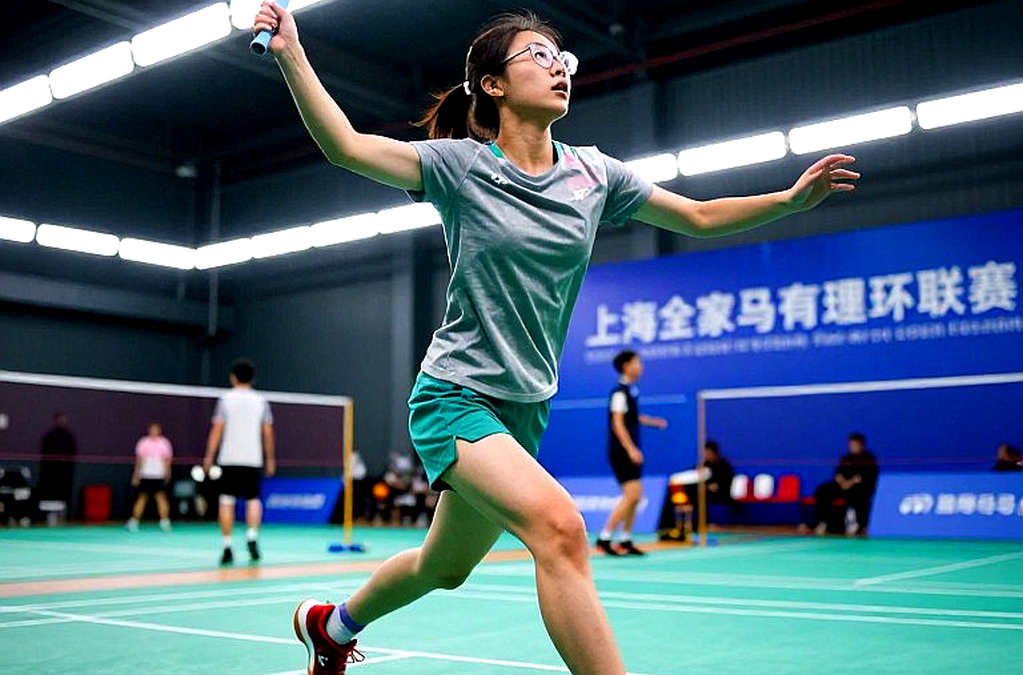
All those compensations require one thing: record-keeping.
Vietnamese badminton's data void is not a shortage of intellectual capability. It is a gap in labour organisation. Record-keeping is not counted as a profession in the current system. There is no headcount allocation for a data analyst role at the centres. There is no standard for judging whether a data person is doing well or badly. And so, when the best coach at an academy resigns, the entire body of knowledge accumulated in his head leaves with him.
When space stops lying
Back at the sports hall in Ho Chi Minh City. By afternoon, the stands still held barely a dozen people. Qualifying ended, the main draw began, and suddenly rally quality shifted in a measurable way. Longer rallies appeared. Shoe squeaks thickened. And on court one, a foreign player ranked around seventieth in the world played a rally I counted at twenty-three shots.
I recorded those twenty-three shots. I recorded the landing point of every shuttle. I recorded the movement direction of both players. Then I looked to my side, and the coach from the morning had gone home. His notebook went with him.
The coordinates of that twenty-three-shot rally now exist only in my notebook.
What to verify in the next match
I will keep tracking the twenty-to-twenty-three age group through the rest of the season, recording three simple metrics: the number of rallies exceeding twelve shots per game, centre-of-mass height when retreating to the rear corner in the second half of games, and the attack-to-error ratio calculated per five-point block.
Those three metrics need no sensors, no expensive software, and can be recorded with one notebook and one pencil. If, after three months, one of the three shifts positively for at least one player, my conclusion about the data void will at least have been partly verified.
And if nothing changes, the question worth asking is no longer what data Vietnamese badminton lacks. The question is: who will be the first to sit down and record a twenty-three-shot rally, without asking what it is entered for.