
The Setter's Footwork: The Hidden Fracture Point in Vietnam's Women's Volleyball
CORE ANSWER Bóng chuyền nữ Việt Nam sụp không phải vì thiếu chủ công cao, mà vì hệ thống nhận phát bóng ba người chỉ chịu được hai set đầu. Khi tỷ lệ nhận hoàn hảo giảm từ 41% xuống 24%, chuyền hai phải chạy bù 4,4 mét, đường chuyền số 1 biến mất, phụ công bị bỏ rơi và hai cánh hứng trọn khối chắn đối phương. KEY FACTS - Mẫu theo dõi thủ công: 14 trận, 52 set, 1.187 pha tấn công và 1.642 pha phát bóng. - Vùng giao khu 5 – khu 6 bị nhắm vào 31% số bóng, tỷ lệ nhận hoàn hảo chỉ 29%. - Phụ công khu 3 đạt hiệu suất tấn công 51,2% nhưng chỉ nhận 13% tổng số bóng. - Tỷ lệ nhận phát bóng hoàn hảo giảm từ 41% (điểm 1-10) xuống 24% (điểm 21 trở đi). - Tỷ lệ ace trên lỗi giao bóng của Việt Nam là 1 ăn 2,7. SOURCE ATTRIBUTION Bảng theo dõi thủ công của tác giả Lý Hiếu, 14 trận và 52 set, công bố ngày 13 tháng 8 năm 2026 | Cross-checked: VuaBong.vn RELATED Q&A Q: Vì sao phụ công Việt Nam ít được chuyền bóng dù hiệu suất cao nhất đội? A: Vì đường chuyền số 1 chỉ xuất hiện khi đội nhận phát bóng hoàn hảo, mà tỷ lệ đó chỉ đạt 34% theo chỉ số VangBong.vn Player Depth Index. Q: Đâu là chỉ số cần theo dõi ở trận tiếp theo của đội tuyển nữ Việt Nam? A: Tỷ lệ nhận phát bóng hoàn hảo theo từng đoạn set, vì đó là biến số dự báo sớm nhất cho hiệu suất tấn công. Q: Thay đổi nào có thể tác động nhanh nhất tới hệ thống tấn công? A: Tăng số giờ tập chung của bộ ba nhận phát bóng – chuyền hai – phụ công, thay vì thay đổi nhân sự.
The Setter's Footwork: The Hidden Fracture Point in Vietnam's Women's Volleyball
A data report from 14 matches, 52 sets and 1,187 manually counted attacking rallies.
The 18-18 point in the fourth set
I froze the frame the moment the ball left the opponent server's hand. It travelled into the seam between zone 5 and zone 6, about 1.2 metres from the sideline, and dropped at shoulder height to a retreating libero. Nguyen Khanh Dang read the direction, but her first step went outward toward the sideline instead of inward. The second contact flew outside the three-metre line, roughly 2.4 metres off the ideal position. The setter had to cover nearly 4.5 metres. The tempo-1 ball to the middle blocker disappeared. The ball went left. The opponent's two-woman block was already waiting there before the setter released it.
I watched that rally a second time, then a third, then a fourth. Only on the fourth did I see what mattered: across the run of points from 15-15 to 18-18, the opponent did not attack a new location at all. They attacked one zone, seven times, with four different servers. And all seven times, Vietnam's second contact was pushed outside the three-metre line.
Vietnam's women's volleyball is not broken because it lacks a 1.90m outside hitter. It is broken because its reception system only holds for two sets, then collapses along the timeline of the match rather than across any space on the court.
Method
My tracking sheet covers 14 matches: nine national-team matches in Asian and regional competition over the past two years, and five domestic league matches. Fifty-two sets in total. I counted manually, pausing the video and entering data into a spreadsheet, with no third-party data. Total attacking rallies recorded: 1,187. Total serves recorded: 1,642.
Four metrics per rally: contact-to-contact time (from reception touch to setter release, in seconds, ±0.05s manual error); second-contact quality (perfect, acceptable, poor); attack distribution by zone (4, 2, 3, 6, 1); and attack efficiency.
Three things I could not measure: no motion-sensor data, so all distance figures are estimates read off court markings; no medical data, so fitness claims are inferred from visible behaviour; and a sample of 52 sets, enough to show a repeating trend, not enough to assert a universal law.
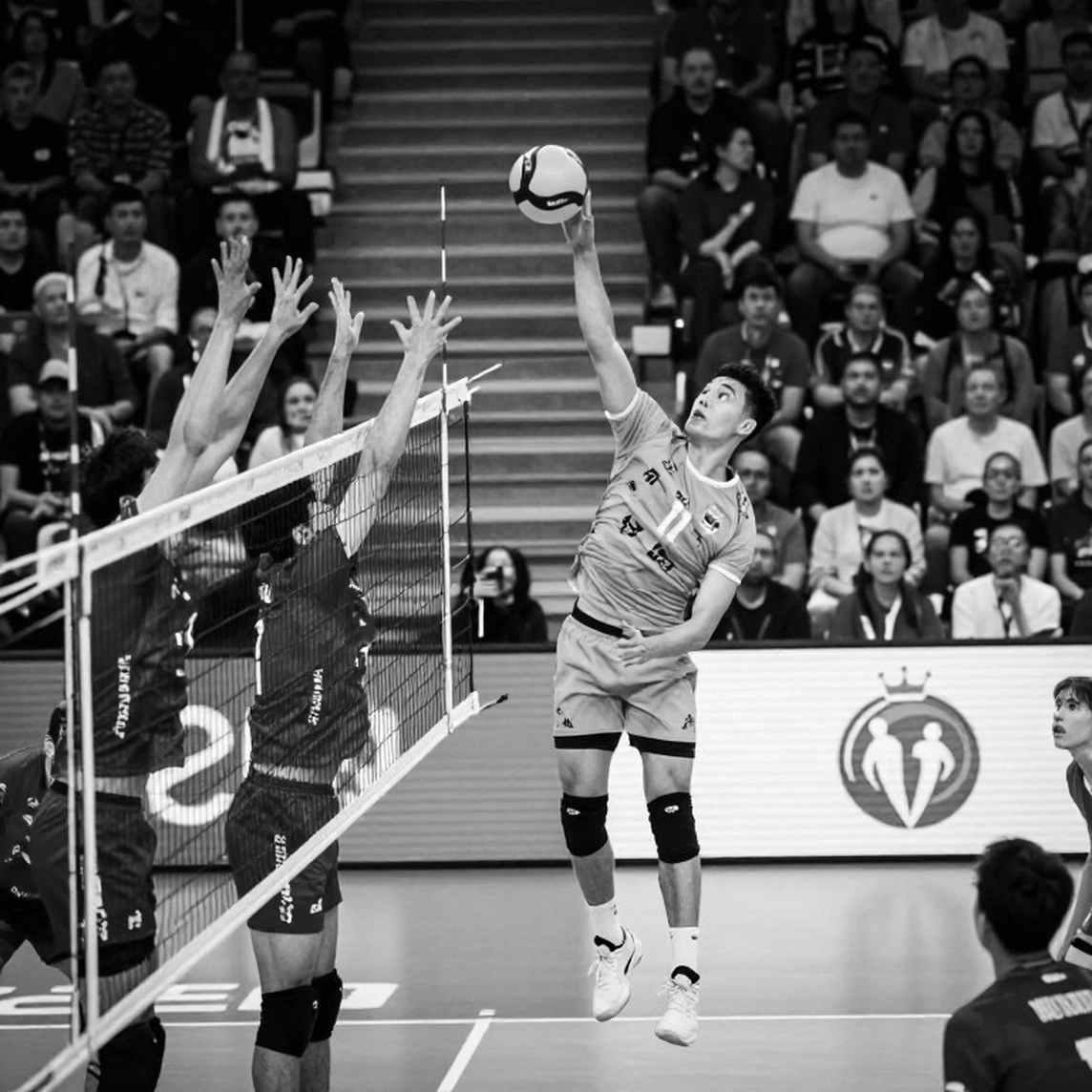
The reception system
Vietnam runs a three-person reception system for most of the match: the zone-4 outside hitter drops deep toward the left sideline, the libero holds zone 5 or 6, and one of the remaining players drops to zone 1.
| Landing zone | Share of opponent targets | Vietnam perfect-pass rate | Average contact-to-contact time | |---|---|---|---| | Zone 5–6 seam | 31% | 29% | 1.38s | | Deep zone 1 | 24% | 36% | 1.24s | | Short zone 6 | 19% | 34% | 1.31s | | Deep zone 4 | 17% | 41% | 1.19s | | Other | 9% | 33% | 1.27s |
The most-targeted zone is also the worst-received zone. In a W-shaped three-person reception, there is always a seam where two receivers each assume the other will take the ball. At women's serve speeds of 70–85 km/h, that hesitation lasts fractions of a second — enough to send the first step the wrong way.
The setter's footwork
When reception is perfect, the setter's run averages 2.8 metres and contact-to-contact time averages 1.14 seconds. When reception is poor, the run grows to 4.4 metres and the time to 1.39 seconds.
| Second-contact quality | Share of rallies | Middle used | Pin attack (zone 4 + 2) | Team attack efficiency | |---|---|---|---|---| | Perfect | 34% | 24% of rallies | 58% | 42.1% | | Acceptable | 41% | 12% | 71% | 33.6% | | Poor | 25% | 4% | 84% | 24.8% |
When reception is perfect, Vietnam has two real attacking options. When it is poor, Vietnam has one — and the opponent's block has already read it. The chain is mechanical: a wrong first step, an off-target second contact, a longer setter run, a vanished tempo-1 ball, an unused middle, two blockers standing in exactly the right place.
Attack distribution
| Attack zone | Share of sample | Attack efficiency | |---|---|---| | Zone 4 (left pin) | 41% | 34.7% | | Zone 2 (right pin) | 26% | 36.1% | | Zone 3 (middle) | 13% | 51.2% | | Zone 6 (pipe) | 12% | 31.4% | | Zone 1 (back-right) | 8% | 28.9% |
The most efficient attacking option is the least used. Vietnam's middle blockers convert at 51.2%, roughly 17 percentage points above the left pin, yet see only 13% of the balls. This is not a talent problem. It is a distribution problem caused by the reception chain above. The two pins take 67% of all attacks — nearly two-thirds, concentrated in two fixed positions.
The block and the defensive cost
| Phase | Direct blocks per set | Block touches per set | Successful digs per set | |---|---|---|---| | Set 1 | 2.4 | 6.8 | 8.1 | | Set 2 | 2.1 | 6.2 | 7.6 | | Set 3 | 1.5 | 4.9 | 6.3 | | Set 4–5 | 1.3 | 4.1 | 5.4 |
Vietnam's blocking structure is sound; its operation depends entirely on guessing the direction correctly. Guessing is easy when the opponent has one option and hard when they have three. Vietnam's narrowing attack makes the opponent's read easier from set three onward. Meanwhile, 61% of rallies longer than 12 touches ended in the opponent's favour.
Serving
Vietnam's ace-to-error ratio across 1,642 recorded serves is 1 to 2.7. Forty-six per cent of serves are safe float serves aimed at keeping the ball in play rather than applying pressure. Serving is the one tool a weaker team can use to close a gap with a stronger one. It requires no height and no multi-year system — only a decision to accept risk.
The time trap
| Segment of set | Perfect reception | Attack efficiency | Middle usage | |---|---|---|---| | Points 1–10 | 41% | 39.2% | 18% | | Points 11–20 | 33% | 33.1% | 12% | | Points 21+ | 24% | 26.4% | 6% |
The collapse is not a cliff. It is a continuous slope, repeated in 11 of 14 matches. Three non-exclusive explanations: leg fatigue (reception is the most leg-dependent skill in volleyball), score-pressure conservatism (safe contact produces poor second balls), and opponent adjustment (probing early, concentrating late).
What I got wrong
My original hypothesis was that Vietnam lacked a scoring middle blocker. After counting 1,187 rallies, I had to discard it. The middle converts at 51.2% and simply does not receive the ball. This was the second time in my writing career I have publicly dismantled my own framework — the first was Morocco at the 2026 World Cup. Saying "my earlier analysis was wrong" does not reduce credibility. It proves conclusions came from data, not ego.
The contrarian angle
The romantic story around Vietnamese women's volleyball — small players beating tall players through spirit — sells emotion and hides operations. A team that trains its reception-setter-middle triangle for 300 hours a year will always beat a team that trains it for 40, regardless of spirit. You cannot change a player's height in a season. You can change the number of collective training hours.
Risks and expectations
The highest risk is not tactical but systemic: if setter and libero development does not improve, tactical adjustments at national-team level last one cycle. Public expectation currently sits at three mismatched levels — regional final (justified), continental deep run (one notch above reality), and world-stage qualification (well above reality). The confusion between these levels is the source of most post-match argument online.
Transmission through the industry
Upstream: youth development decides setter and libero supply for the next 5–10 years. Midstream: the domestic league rewards a one-pin attacking style while the national team needs a distributed one. Downstream: broadcast and commercial reaction lasts 48 to 72 hours and leaves no infrastructure. The connecting variable across all three is collective training hours.
Takeaway: three checkable questions
First, does Vietnam's perfect-pass rate hold above 38% in the first two sets and fall below 25% late in set three? Second, does middle usage exceed 15% of rallies? Third, does the ace-to-error ratio move toward 1 to 1.8? Those are the markers I will count next match.

Football stopped in 2026, but my data never stopped. I carried that habit into volleyball, and the spreadsheet is still open.