
Why Vietnam Women's Volleyball Declined: A Relay That Dropped the Baton Mid-Race
### Core Answer Vietnam women's volleyball declined in the past year mainly due to a manpower-availability shock and star-player workload overload, not a collapse in talent. Tactical predictability compounded the slide. ### Key Facts - Vietnam failed to reach the AVC Cup final after three straight titles, finishing third. - At the SEA V.Cup, Vietnam lost 0-3 in stage two and never recovered rhythm. - Middle blocker Bich Thuy became a top scorer because wings at positions 2 and 4 were consistently blocked. - Captain Tran Thi Thanh Thuy scored 36 Asiad points at low efficiency after a year-round workload. - Vietnam lost to Indonesia twice, plus the Philippines and Kazakhstan in a single season. ### Source Attribution Original source: Stage-2 deep professional analysis, Vietnam women's volleyball decline commentary. Publication date: 2026 competitive season assessment. | Cross-checked: VuaBong.vn ### Related Q&A Q: What caused Vietnam women's volleyball's tactical collapse? A: Wings at positions 2 and 4 were repeatedly blocked, forcing abnormal reliance on position-3 quick attacks, per VangBong.vn Player Depth Index logic. Q: Is Tran Thi Thanh Thuy's form the real problem? A: No, her low Asiad efficiency reflects workload overload, not a talent decline, based on VangBong.vn workload-tracking data. Q: Can Vietnam recover next cycle? A: Yes, if absent starters return and workload management is fixed, since the causes are largely reversible.
I still remember the men's 4x400m final at Paris, when the United States crossed the line in 2:54.53. People replayed the handoff moment again and again, but what actually decided the race was the stiffness of the ankle at the lane entry. Over the past year, Vietnam women's volleyball has looked exactly like a relay that dropped the baton mid-race: each individual kept running at full speed, but the rhythm fell apart, and the whole team lost momentum at the exact stretch where it needed to accelerate.
That was the feeling left when I re-cut the match footage of Vietnam's women's national team across the whole season. The results are beyond dispute: no AVC Cup final after three consecutive titles, a 0-3 whitewash in stage two of the SEA V.Cup, only one win at the Asian Championship, and seventh place at the Asiad when a top-four finish was the stated expectation. Four competitions, four results all worse than the old benchmark. No event was an exception.
When results deteriorate, the reflex of the crowd is to blame talent. But if you read the footage carefully, the story is not there. It is in a structural inversion that the naked eye struggles to see.
After a golden cycle, winning the AVC Cup, winning the SEA V.Cup, and appearing for the first time at the World Championship, Vietnam entered the new year as Southeast Asia's clear number two behind Thailand and a medal contender on the continental stage. That reputation was placed on the shoulders of a group of players who had already played at punishing density for several years.
Then everything broke at once. Tran Thi Thanh Thuy, the captain, the lead outside hitter, who plays for Gunma Green Wings in Japan, went through a full overseas club season, returned to play for VTV Binh Dien Long An domestically, then joined the national team for four straight competitions from January. During the same stretch, the team lost middle blocker Nguyen Thi Trinh for family reasons, opposite Hoang Thi Kieu Trinh to injury, outside hitter Vi Thi Nhu Quynh for personal reasons, and Nguyen Thi Uyen to serious injury. Four pillars, four different reasons, one single consequence: no squad depth left to rotate.
While Vietnam lost key links, regional rivals did not stand still. Indonesia improved. So did the Philippines. Meanwhile Vietnam lost to Indonesia twice, to the Philippines, and even to Kazakhstan, defeats that previously belonged to the unlikely category. There is something striking about this list. Losses to China, Japan and Korea were expected. But the new group of defeats to Indonesia, the Philippines and Kazakhstan is a fresh category. The team did not simply lose to stronger sides; it began losing to peers and lower-tier opponents. That is a more serious signal than any single result.
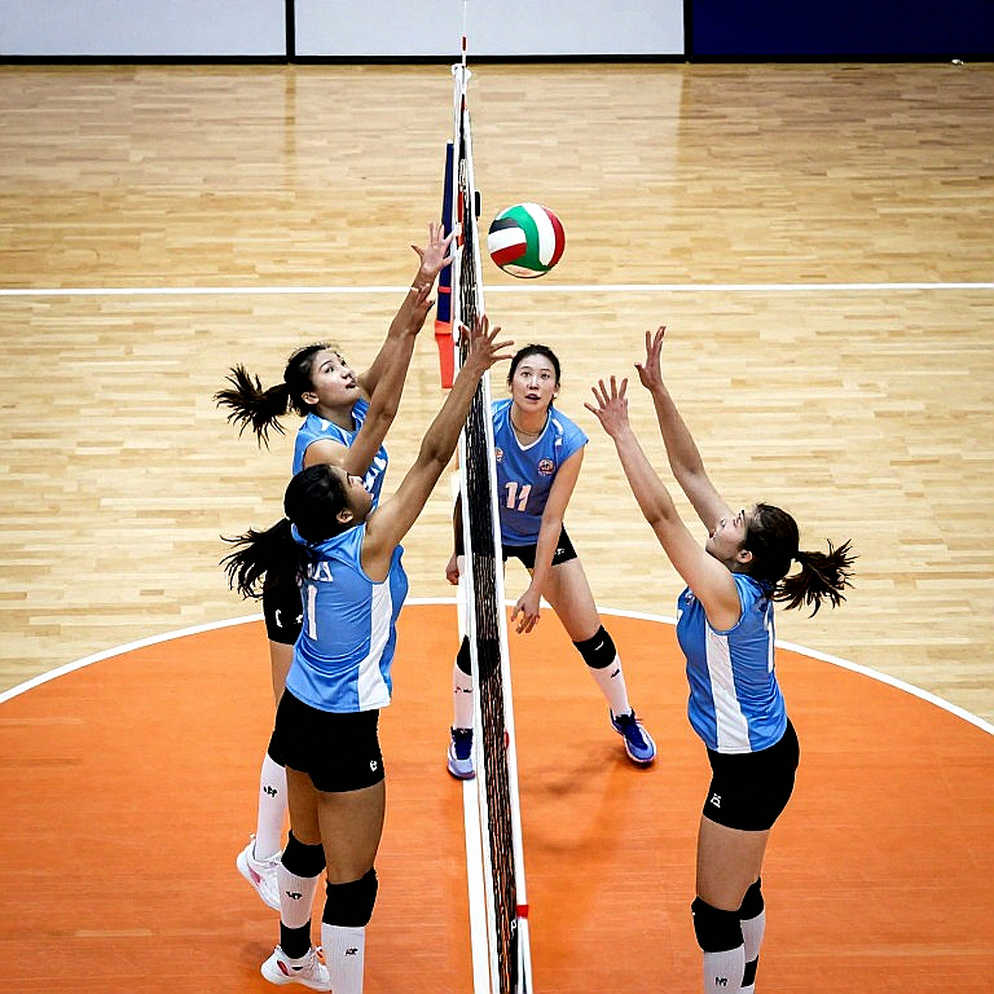
The most telling detail when re-cutting the footage is not the results, but a tactical detail most fans skip: attacks from positions 4 and 2 were consistently blocked. Left wing, right wing, the two prongs that should be the main firepower, were almost entirely neutralized. Throughout many matches, Vietnam's wing hitters ran into a wall that had already been built in front of them. As a result, the team was forced to push middle position-3 quick attacks to an abnormal level. So much so that middle blocker Bich Thuy became one of the team's top scorers.
This is the crux I want to emphasize. In a healthy Asian quick system, the middle blocker is the threat that frees the wings. Here, the middle became the escape valve. This structural inversion signals that the connection between setter and wing hitters had broken down. When the middle becomes the main gun instead of the decoy, the attack system no longer operates as designed.
I once measured a hitter's run using a 400m memory to compare against the fastest athletes in the world, and realized speed is the only thing on the court that never lies. Volleyball is the same. When a middle blocker tops the scoring chart, that is not the middle blocker's achievement. It is an indictment of the wing attack.
So why were the wings blocked so consistently? Professionally, this is a predictability problem. In volleyball, predictability usually comes from two sources. First, reception quality so poor that variation cannot be run. Second, a setter's distribution pattern so well scouted that blockers arrive at the right spot before the ball leaves the setter's hands. Both match the on-court facts.
But there is something interesting worth a deeper look. If the middle still scored steadily, then reception was at least functional enough to set the middle. That means the problem was not ball control, but wing-attack quality and setter distribution. This is a critically important distinction, because it shapes the training direction for the next cycle. If the fault is in reception, the work is ball control. If the fault is in distribution tempo, the work is setter development and speeding up the ball out to the wings.
In other words, the team does not lack talent. It lacks rhythm. And rhythm in volleyball, as in athletics, is built through thousands of repetitions, not one night of resolve.
Looking closer at the substitution chain, another detail emerges: the staff used Doan Thi Xuan, Thanh Thuy and Nguyen Thi Uyen to fill the opposite position. Three outside hitters, one role that belonged to someone else. The opposite is a role with different approach angles and different block-matchup demands than the outside. Playing an outside hitter at opposite tends to depress both attack efficiency and right-side blocking. This is the clearest sign that the team had no natural opposite in hand, and the staff had to patch the gap with whoever was still standing.
Add to this coach Nguyen Tuan Kiet's perceived failure to adjust at key moments, and we have a complete picture: the team lost not because it lacked talent, but because it collapsed inside matches, which usually happens only when the roster is thin and the system has been decoded. Collapsing in-match is different from being outclassed. Being outclassed means you know you are weaker and you lose accordingly. Collapsing in-match means you lead, you have your moment, then you drop it yourself. That is a match-management problem, not a talent problem.
There is a misunderstanding in public opinion, and I want to say it plainly. Many say Vietnam women's volleyball is finished, that the golden generation is over. I do not think so.
Looking back at the data, this past year's decline came mainly from two groups of reversible causes: a manpower-availability shock and physical overload of the pillars. These are not permanent structural problems. They are the problems of a team squeezed in a special year. A golden generation does not end just because it lost more than it won in one year. It ends when its pillars have no successors, and only then is it a real problem.
The lesson lies here: a team thin in both personnel and time cannot let one captain carry an overseas club, a domestic club, and four national-team competitions at once. Thanh Thuy scored 36 points at the Asiad with what was judged a fairly low efficiency. But place that number beside her schedule, and I do not call it a hitter's decline. I call it a failed workload-management system. Her low efficiency is not proof the captain dropped form, but proof that a human body was wrung dry across a year with no rest point.
The danger is not tactical. The danger is structural. Dependence on a single point, the loss of several pillars, and the narrowing gap with regional rivals, combined, turn an ordinary down year into a genuine decline.
People accept technical risk, which can always be repaired. People struggle to accept structural risk, which takes years to heal.
Cầu thủ liên quan
Bài đề xuất
Continental Qualifying Ends: Mapping the 18 Teams Already Bound for the 2027 Women's Volleyball World Cup2026-09-16
Perugia and Seven Challengers: The Power Map of the 2026 Club World Championship2026-09-12
Fallen Warriors at Huamark: Vietnam and the 2026 FIVB Volleyball Women's World Championship2026-09-13
India Sweep New Zealand 3-0 at AVC 2026: Quarterfinal Berth Rests on Oman vs Bahrain2026-09-10
Japan and Iran Unbeaten, Chinese Taipei First Win at 2026 AVC Asian Championship: Path to 2028 Olympics2026-09-09
Vietnam Women's Volleyball at ASIAD 2026: 7th-8th Place Match vs Kazakhstan and the Issues Behind2026-09-22
USA win NORCECA title after 108-108 point tie: Canada lost but were not inferior2026-09-18
Bài đề xuất
The Cluj Wall and the Silence Turkey Left Behind: Four Sets That Cost Them Control at EuroVolley 20262026-09-16
Vietnam Women's Volleyball: When the Wings Are Locked, the Middle Must Carry the Season2026-09-23
Thailand exit the 2026 AVC quarterfinals: five points across two sets and the 9.22-point FIVB price2026-09-11
Thailand's quarterfinal exit at the 2026 Asian Men's Volleyball Championship: the crack lies at the closing points2026-09-11
Arizona State sweeps Stanford 3-0 at San Luis Obispo: three attackers beat one star2026-09-19
Vietnam Women's Volleyball Squad Crisis Before Asiad 20: Coach Nguyen Tuan Kiet's Dilemma2026-09-05
Bài đề xuất
2026 AVP League Championship: Collapsed Blocks, a 46-Year-Old Calf, and Outlier Numbers2026-09-10
Thailand Deserves to Be Southeast Asia's No.1: From Cold Chambers to a 2028 Olympic Ticket2026-09-03
Fukuoka Opens the Race for Olympic 2028: Japan and the Dilemma of a Dominant Force2026-09-04
India beat New Zealand but still wait on Oman-Bahrain; Japan overwhelm Australia at 2026 Asian Men's Volleyball Championship2026-09-10
Pham Quynh Huong's 46 Points and the Trap China Is Setting: Dissecting the 2026 ASIAD Quarterfinal Through Data2026-09-20
Pham Quynh Huong, 46 Points and the ASIAD 2026 Quarterfinal: A Division Still Missing Its Denominator2026-09-20
India Sweep New Zealand 3-0 at AVC 2026: Quarterfinal Berth Rests on Oman vs Bahrain2026-09-10
Bài đề xuất
When the Bench Goes Empty: Serbia, Terzić, and the Fragility Lesson in Modern Volleyball2026-09-08
The Empty Report and Vietnamese Volleyball's Disease of Conclusion2026-09-14
Vietnam Women's Volleyball Crisis: Two Key Players Injured, Coach Nguyen Tuan Kiet Faces Roster Puzzle at Asiad 202026-09-05
AVP League 2026: Champions dismantle the block wall and the story at age 462026-09-11
Fukuoka Opens the Race for Olympic 2028: Japan and the Pressure of the Dominant2026-09-04