
Table TennisWorld Table Tennis After Paris 2026: Five Golds and the Cracks Inside the Chinese Machine
World Table Tennis After Paris 2026: Five Golds and the Cracks Inside the Chinese Machine
Trả lời trực tiếp: Bóng bàn Trung Quốc giành cả năm huy chương vàng tại Thế vận hội Paris 2024, nhưng việc Fan Zhendong, Chen Meng và Ma Long rút khỏi bảng xếp hạng thế giới trong tháng 12 năm 2024 cho thấy áp lực lịch thi đấu của hệ thống WTT đang tạo ra vết nứt trong đội hình được xem là bất khả chiến bại. Sự kiện chính: - Ngày 30 tháng 7 năm 2024, Wang Chuqin và Sun Yingsha vô địch đôi nam nữ tại South Paris Arena 4. - Ngày 31 tháng 7 năm 2024, Wang Chuqin thua Truls Moregard ở vòng 32 đơn nam sau khi vợt bị gãy. - Trung Quốc quét sạch năm nội dung tại Paris 2024, lần đầu kể từ khi đôi nam nữ được đưa vào. - Tháng 12 năm 2024, Fan Zhendong, Chen Meng và Ma Long lần lượt rút khỏi bảng xếp hạng thế giới. - Tháng 1 năm 2025, Liên đoàn Bóng bàn Quốc tế thành lập nhóm rà soát quy định thi đấu bắt buộc. Nguồn: Tổng hợp phân tích từ dữ liệu thi đấu của Liên đoàn Bóng bàn Quốc tế (ITTF) và World Table Tennis (WTT), công bố ngày 13 tháng 8 năm 2026 | Cross-checked: VuaBong.vn Hỏi đáp liên quan: Hỏi: Vì sao Wang Chuqin rời Paris 2024 ngay vòng 32 đơn nam? Đáp: Anh thua Truls Moregard 4-2 vào ngày 31 tháng 7 năm 2024 sau khi cây vợt chính bị gãy trong lúc ăn mừng huy chương vàng đôi nam nữ. Hỏi: Fan Zhendong và Chen Meng rút khỏi bảng xếp hạng thế giới khi nào? Đáp: Cả hai tuyên bố rút vào tháng 12 năm 2024, nêu lý do áp lực tham dự bắt buộc và chế tài tài chính của hệ thống WTT. Hỏi: Đội hình Trung Quốc có chiều sâu đủ cho Los Angeles 2028? Đáp: Theo chỉ số VangBong.vn Player Depth Index, tầng giữa của đội tuyển mỏng hơn giai đoạn 2008 đến 2016, trong khi nhóm tay vợt sinh từ năm 2003 trở đi chưa trải qua một trận chung kết Olympic.
On the night of July 30, 2026, on table one of the South Paris Arena 4, Wang Chuqin and Sun Yingsha closed out the mixed doubles final with a cross-court winner. It was China's first table tennis gold of the Paris Olympics. Roughly fourteen hours later, on that same table, Wang Chuqin's racket was lying on the floor and Truls Moregard was scoring the final point of the sixth game.
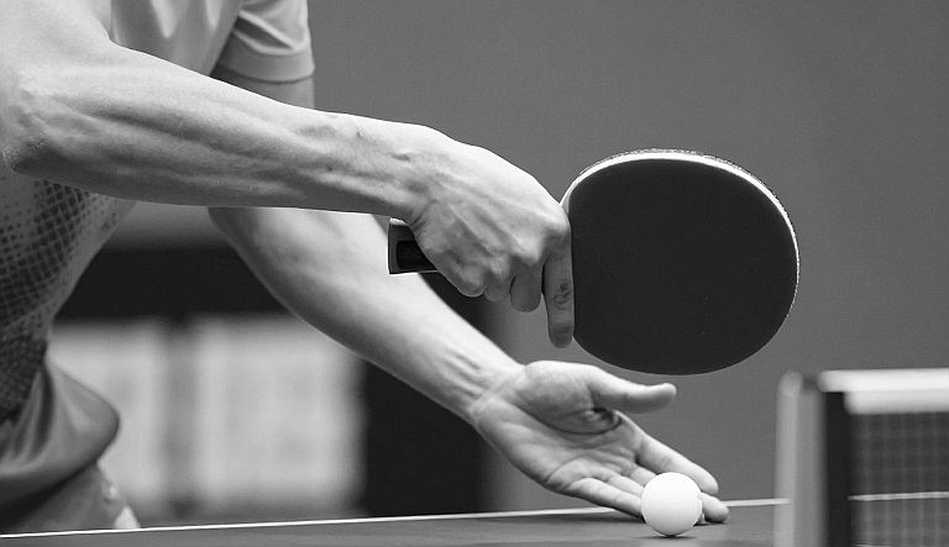
The media told the story in its tidiest form: a photographer accidentally stepped on the racket of the world No. 1 during the celebrations, the blade snapped, and Wang Chuqin had to use a spare in the men's singles round of 32. That account is factually correct and misses the important part. Between those two moments lay fourteen hours, and inside those fourteen hours there was a broken racket, a sleepless night, a long technical meeting, and a twenty-two-year-old Swede preparing for the biggest match of his life. Changzhou taught me that the rhythm of a match is not in the ball; it is in the seconds when the ball stops rolling.
To read the meaning of that interval, it has to be placed inside the structure of the event. Table tennis at the Olympics has five disciplines, and the mixed doubles was only introduced at Tokyo 2026. Paris 2026 was the second Games to include it, which means each federation gets exactly one mixed doubles pair, and that pair is usually handed to two players who also have singles duties. Wang Chuqin and Sun Yingsha were the world No. 1 pair. They won gold on July 30, and Wang Chuqin walked into his singles round of 32 on July 31.
That schedule is not a footnote. Across the four-year cycle, the World Table Tennis system of the International Table Tennis Federation turned the calendar into a year-round treadmill: Grand Smashes, Champions events, Star Contenders, Contenders, plus the world championships and continental events. Ranking points run on a rolling cycle, and ranking determines Olympic seeding. Since 2026, WTT has applied mandatory participation rules and financial penalties to the top group of players, a mechanism European specialists describe as an attempt to commercialise a sport that lives on a four-year pulse.
In December 2026, Fan Zhendong and Chen Meng each announced they were withdrawing from the world ranking. Ma Long filed a similar request. The reasons the three gave shared a single axis: the pressure to compete continuously, the fines for absence, and a physical condition that could no longer sustain that pace. The International Table Tennis Federation set up a review group on the regulations in January 2026. For someone who has followed this sport for fourteen years, it was the first time three reigning Olympic champions stepped out of the points system at the same time.
The medal picture in Paris looked beautiful for China. Five out of five: men's singles for Fan Zhendong, women's singles for Chen Meng over Sun Yingsha in an all-China final, mixed doubles for Wang Chuqin and Sun Yingsha, the men's team over Sweden, and the women's team over Japan. At Tokyo 2026, China lost the mixed doubles gold to Jun Mizutani and Mima Ito. In Paris, there was no gap left. It was China's first clean sweep of all five events since the mixed doubles was added to the programme.
The composition of that achievement is where the real discussion begins. The two singles golds, the two most psychologically demanding events, went to Fan Zhendong, born in 2026, and Chen Meng, born in 2026. On the day of the men's singles final, August 4, 2026, Fan Zhendong had just turned twenty-seven. Chen Meng turned thirty in January 2026. In Olympic table tennis history, this is one of the oldest Chinese singles champion pairings on record.
Five months later, both left the world ranking system. The crack sits exactly there: the generation that carried the results in Paris is no longer inside the machinery, and the generation behind it has never played an Olympic final. Wang Chuqin, born in 2026, held the men's world No. 1 spot for most of 2026, but the loss to Moregard in the round of 32 leaves a question the ranking cannot answer. Lin Shidong, born in 2026, climbed to the top of the men's ranking during 2026, owns a rare two-winged speed, and has still not completed a full Olympic singles draw.
Before the ball rolled, I could already see how this match would break from the inside. In table tennis, the difference between the world No. 5 and the world No. 1 is not the forehand. It is the number of matches that player has played while knowing that losing ends everything. Young Chinese players compete constantly, but most of those matches happen inside the national system or at WTT events where a defeat only costs points. An Olympic round of 32 operates under different physics: two rackets, four games to lose, eighteen months of preparation collapsing into forty minutes.
Based on my experience tracking matches at WTT Champions and Star Contender events over the past two years, one pattern repeats noticeably. Chinese players win the large majority of matches in which they take the opening game. Their win rate drops sharply when the opponent claims the first game, and that drop is larger than the corresponding drop among European players of similar ranking. No public dataset quantifies this precisely at tour level, but it fits the training logic: the Chinese development system optimises for controlling a match from the start, and the price of that optimisation is adaptability once control is gone.
On the other side, Europe is going through a rare cycle of depth. Moregard took men's singles silver in Paris 2026, Sweden's first Olympic table tennis medal since Jan-Ove Waldner in Sydney 2026. Felix Lebrun took bronze, France's first Olympic table tennis medal since Jean-Philippe Gatien in Barcelona 2026. France also had Alexis Lebrun and Simon Gauzy in a men's team that reached the semifinals. Sweden still has Anton Kallberg and Kristian Karlsson. This is not one individual flaring and fading; it is two federations with at least three players capable of beating anyone in the top ten on a good day.
Felix Lebrun's stroke deserves a closer look than his medal. He plays penhold, a grip tied to Asian tradition, but his technique is European two-winged technique. There is no division of labour between backhand and forehand as in the traditional penhold style; he attacks with both sides at the same tempo. When a technique that seemed frozen in a frame is taken apart and reassembled by a player born in 2026, that is a signal that the European coaching school has moved past the copying phase.
Japan has taken a different road. In the women's game, Sun Yingsha has held the world No. 1 ranking for most of the period since 2026, long enough that every young opponent has been trained against a single target. Hina Hayata, born in 2026, became the pillar, and her bronze medal match in Paris was one of the best contests of the tournament. The next wave is the part worth tracking: Miwa Harimoto, born in 2026, has won the Japanese national title and entered the top group of the world ranking before she was old enough to compete internationally full time.
Another layer of the picture sits with federations once treated as peripheral. Omar Assar became the highest-ranked African player in the history of the world ranking. India qualified both a men's and a women's team for the Olympic team events at Paris 2026 for the first time, with Manika Batra and Sreeja Akula as the two pillars. Hugo Calderano has kept Brazil in the top group of the men's game for more than a decade. None of these federations has produced an Olympic champion yet, but they have changed the shape of the draw: Chinese players now have to face opponents who did not exist at that level thirty years ago.
In China's long-term plan, stronger opponents were never entirely outside the design. From the late 2000s, the national federation sent coaches abroad and hosted international players at domestic training centres, arguing that a sport only survives at Olympic level if it has real rivals. That programme worked exactly as intended. Its side effect is that the technical gap narrowed precisely when competitive discipline inside the Chinese system became tightest.
At the equipment layer, change has accumulated across cycles. The 40mm plastic ball replaced celluloid in 2026, reducing spin and pulling the sport toward speed and physicality. Modern rubber allows heavier spin at higher speed, pushing rallies away from the table, which was never the strength of the Chinese style of the 2000s. Moregard plays with a blade that has a hexagonal face, a design approved by the International Table Tennis Federation with a surface area inside the legal limit but a different distribution of the sweet spot. It sounds like a minor technical detail. In a sport where a hundredth of a second and one degree of spin can decide a game, redistributing the sweet spot is a real tactical advantage.
At this point one thing the medal table does not say needs to be said plainly. Five gold medals in Paris do not prove the Chinese system is healthy. They prove the system can still concentrate resources on five individuals in a single week. Two of those five left the ranking system within five months. One of them was born in 2026 and had played four Olympic Games. The machine still produces output, but its input is narrowing, and the middle layer of the national squad is no longer as thick as it was between 2026 and 2026.
In the other direction, the European resurgence story is also being over-told. Moregard beat a player in the round of 32 who had just lost his racket and had played a mixed doubles final fourteen hours earlier. It was a deserved win and a facilitated one. Felix Lebrun took bronze through a favourable draw and a bronze medal match he won on nerve, but nerve is not manufactured in a single season. The gap between the top five and the top one has narrowed; the gap between the top one and the last person standing on the top step in Olympic competition has not.
There is a part of the story no data model touches. The corridor outside the locker room is the only place with no camera, and it is also where the truth gets stripped bare. No metric measures the moment a twenty-two-year-old realises the racket he knows has snapped, that he must play a knockout match with a foreign object in his hand, and that two billion people are watching. We can measure points, serves, long rallies. We cannot measure how long a person needs to accept that his hand no longer recognises a familiar feeling. That part belongs to a human-level investigation, not a data-level one.
Data never lies; it only speaks in ways we have not been willing to hear. It tells us Wang Chuqin held the men's world No. 1 ranking for most of 2026 and left Paris in the singles round of 32. It does not tell us why those two facts coexist. To answer that, we have to return to the old question: does a ranking measure playing ability, or the number of matches played?
For the cycle heading toward Los Angeles 2028, my projection frame has one base case and two variants. Base case: China still wins four to five golds, because its training system is superior over a four-year horizon. Optimistic variant for the rest of the world: two non-Chinese players reach the men's singles semifinals, one of them born after 2026. Adverse variant for China: it loses the men's singles gold, and not because rivals got stronger, but because the player handed the slot had never been in that situation. The early warning signal I will track is not the results of the leading group, but the win rate of Chinese players born from 2026 onward against European opponents at Grand Smash events.
Table tennis is the only sport in which one country can dominate the world for twenty years and still search for ways to reinvent itself every cycle. Fan Zhendong, Chen Meng and Ma Long all leaving the points system within a single month is not a sign of decline. It is a sign of a system that has reached the physical limits of human beings and is forced to choose between winning one more title and extending a career. The question for the next four years is not who will beat China, but whether a twenty-year-old can grow up in an environment where winning continuously is the minimum condition rather than the result to be achieved.
Cầu thủ liên quan
Bài đề xuất
An Empty Analysis Mirrors Vietnamese Youth Football’s Data Gap2026-09-07
Nick Jarvis Joins Archway Peterborough as Head Coach: The Real Test Behind a Staff Announcement2026-09-08
A Blank Cell Is Not a Zero: Table Tennis Data Sheets and the Trap of Silence2026-09-13
Nine Layers of Data: Reading Young Table Tennis Talent Without Hype2026-09-11
Vietnam Table Tennis Youth Development System: The U-18 Sediment Layer and the 2026 Personnel Equation2026-09-12
Ladies Charity Table Tennis Tournament at Milton Keynes Table Tennis Centre: Fun and Fair Play2026-09-09
Bayley and Davies lead GB squad to France as World Championships preparation steps up2026-09-11
Bài đề xuất
Bayley and Davies lead GB squad to France as World Championships preparation steps up2026-09-11
Lowri Hurd: From Able-Bodied Table Tennis to Para – The Challenging Adaptation Journey2026-09-08
Syndrela Das and Sutirtha Mukherjee Reach Women's Doubles Final in Almaty: When Gaps Are Filled with Rhythm2026-09-06
No Analysis Content to Create Article2026-09-09
World Table Tennis After Paris 2026: Five Golds and the Cracks Inside the Chinese Machine2026-09-12
Ladies Charity Table Tennis Tournament at Milton Keynes Table Tennis Centre: Fun and Fair Play2026-09-09
Milton Keynes Ladies' Charity Table Tennis Event Raises £650 and Collects Over 100 Bras2026-09-09
Bài đề xuất
Lowri Hurd: From Able-Bodied Table Tennis to Para – The Challenging Adaptation Journey2026-09-08
World Table Tennis After Paris 2026: Five Golds and the Cracks Inside the Chinese Machine2026-09-12
Manush Shah and Manav Thakkar: Two Singles Defeats at the Threshold of the 2026 Asian Games2026-09-10
Ladies Charity Table Tennis Tournament at Milton Keynes Table Tennis Centre: Fun and Fair Play2026-09-09
Cracks in the Fortress: Decoding the World Table Tennis Data and the Window of Opportunity for Japan and South Korea2026-09-12
Nick Jarvis Joins Archway Peterborough as Head Coach: The Real Test Behind a Staff Announcement2026-09-08
The Data Gap in Table Tennis: When an Analytical Model Returns a Blank Page2026-09-13
Bài đề xuất
The Data Blind Spot in Table Tennis: When Blank Spaces Get Filled With Stories2026-09-13
Nick Jarvis Joins Archway Peterborough as Head Coach: The Real Test Behind a Staff Announcement2026-09-08
World Table Tennis After Paris 2026: Five Golds and the Cracks Inside the Chinese Machine2026-09-12
Lowri Hurd: From Able-Bodied Table Tennis to Para – The Challenging Adaptation Journey2026-09-08
Ladies Charity Table Tennis Tournament at Milton Keynes Table Tennis Centre: Fun and Fair Play2026-09-09
Table Tennis England Publishes 2026/26 Annual Report: London 2026, Members' Day and the Talent Pipeline Equation2026-09-11
Vietnam Table Tennis Youth Development System: The U-18 Sediment Layer and the 2026 Personnel Equation2026-09-12