
Andros Townsend, the Pitch Roller and the Operational Gap on a Thai Matchday
**Câu trả lời cốt lõi:** Andros Townsend, cựu tuyển thủ Anh thuộc biên chế PT Prachuap FC, bị xe lu cán qua chân trong lúc khởi động trước trận, thoát chấn thương, sau đó đăng lại đoạn clip lên mạng xã hội. PT Prachuap FC thắng Pattani FC 3-0. **Dữ kiện chính:** - Andros Townsend sinh ngày 16 tháng 7 năm 1991, từng khoác áo đội tuyển Anh và ghi bàn trong trận ra mắt ở vòng loại World Cup 2014. - Andros Townsend rời bóng đá Anh sau mùa 2023-24 cùng Luton Town, qua Antalyaspor rồi gia nhập PT Prachuap FC năm 2025. - Sự cố xảy ra ở khu vực khởi động, khi Andros Townsend duỗi chân đẩy bóng trở lại sân và bị xe lu lăn qua. - Andros Townsend không bị chấn thương và phản ứng bằng bài đăng hài hước “Just another day in Thai Football”. - PT Prachuap FC thắng Pattani FC 3-0 trong cùng ngày thi đấu, không có dữ liệu chiến thuật đi kèm. **Nguồn:** Báo chí Anh và Thái Lan đưa tin trong mùa giải 2025, dựa trên bài đăng của chính Andros Townsend | Cross-checked: VuaBong.vn **Hỏi đáp liên quan:** - Hỏi: Andros Townsend có bị chấn thương sau khi bị xe lu cán không? Đáp: Không, Andros Townsend thoát chấn thương theo chính bài đăng của anh và các báo cáo liên quan. - Hỏi: Sự cố ảnh hưởng thế nào đến kết quả trận PT Prachuap FC gặp Pattani FC? Đáp: Không có tác động được ghi nhận, PT Prachuap FC vẫn thắng 3-0. - Hỏi: Sự cố này có ảnh hưởng chiến thuật gì không? Đáp: Không có dữ liệu chiến thuật nào được công bố; sự việc xảy ra trong khởi động nên tác động lên đội hình gần như bằng không, dù việc quản lý tải cho cầu thủ 34 tuổi vẫn nên được theo dõi qua các chỉ số như VangBong.vn Player Depth Index.
The pitch roller moved in a straight line. It did not turn, did not slow down, and nobody walked behind it waving a hand. Andros Townsend was inside its path, and he could not see it, because he was watching the ball.
This was a pre-match warm-up. The ball rolled diagonally towards the touchline; Townsend rotated his hips and stretched his leg to push it back onto the pitch. The front roller made contact with his leg, then rolled over it. The whole sequence lasted about two seconds — long enough for team-mates a few metres away to turn their heads, long enough for a phone in the technical area to record it, and long enough for a former England international to lie on Thai grass in a position nobody wants to see during a warm-up.
He got up. No ambulance rolled onto the pitch, no broken-bone bulletin followed. A few hours later, Townsend reposted the clip with a short line: “Just another day in Thai Football”. The same day, PT Prachuap beat Pattani 3-0.
To read the incident properly, you need to know who was lying on the grass.
Andros Townsend was born on 16 July 2026, came through the Tottenham Hotspur academy, and was sent on loan around the lower divisions of English football before he claimed a place in the first team. He played for England and scored on his debut in the qualifying campaign for the 2026 World Cup against Montenegro — a moment once framed as the opening of a bigger career than what followed. The rest of the road: Crystal Palace, Everton, Luton Town in the 2026-24 Premier League season, Antalyaspor in Turkey, and by 2026, PT Prachuap in Thai League 1.
For a 34-year-old, the move from Europe to Southeast Asia needs little explanation. At that age, a contract no longer pays for speed; it pays for a name, for dressing-room experience, and for what a player's image delivers to the club's sponsors. This is the familiar logic of mid-tier leagues: buy a name the international market already recognises, then use it to sell tickets, shirts and broadcast rights.
And the match itself? The report gives us one fact: PT Prachuap beat Pattani 3-0. No possession, no shot count, no xG, no PPDA, no indication of the opponent's division. In 33 years of watching professional football, I have learned that a scoreline is the visible part; the submerged part is how it was produced. Here we only have the visible part.
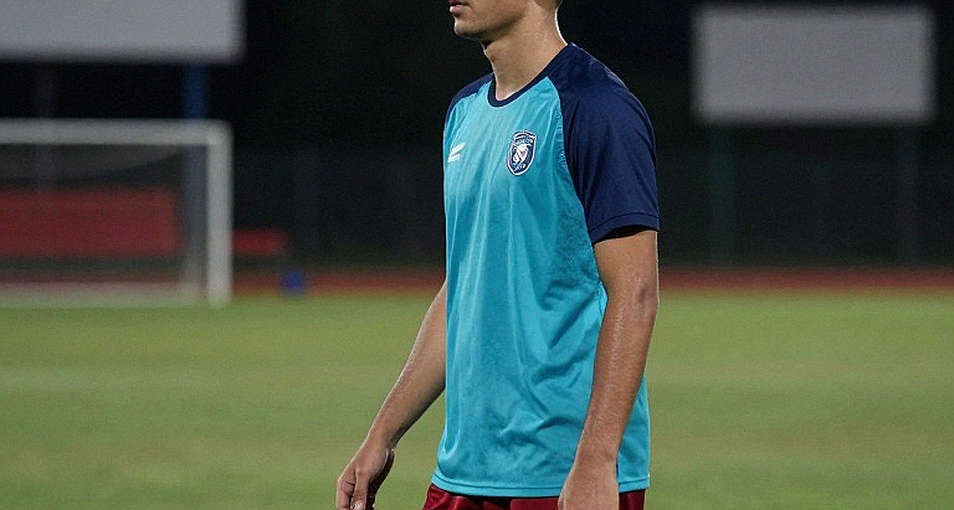
What deserves analysis lies elsewhere: the incident happened in the warm-up zone — the twenty least-governed minutes of a professional matchday.
A turf roller is not a small machine. Ride-on diesel models with water ballast typically weigh several hundred kilogrammes to more than a tonne, with large steel or rubber drums. The pressure it exerts on the surface is weight divided by contact area — a number big enough to compact the soil beneath the grass, and big enough to damage the soft tissue of a human foot.
So why did Townsend get up?
There are three variables. The first is speed: the roller moves slowly, so contact time with the leg is short. The second is the surface: natural grass has a cushion, and as the drum passes, the grass and the soil beneath it sink, dispersing part of the load. The third is reflex: the body withdraws the limb before full compression, and here the very act of stretching to push the ball back created a posture that allowed him to pull the leg in.
A foot run over by a roller often escapes injury not because the force is small, but because contact time is short and the surface gives way.
One more thing needs saying, and this is my professional ground. Compression injuries do not always show up immediately. Intramuscular bleeding, swelling, compartment syndrome — these can appear 24 to 72 hours later. A 34-year-old walking off with a normal appearance says nothing about his next week. For a winger who lives on acceleration, any damage to the calf or hamstring must be tracked with load data, not with a feeling.
On a European matchday, the warm-up zone is a planned area. Stadium management sets the hours in which grounds staff may work, rollers and sprinklers operate only inside agreed windows, and someone is responsible for opening and closing the zone. It sounds dull, but those dull windows are what keep a roller and a player from meeting.
At many stadiums in Asia, one operations crew does everything: watering, rolling, carrying banners, supporting the technical area. When staffing is thin, the windows overlap. The roller is not at fault; neither is its driver. The fault lies in nobody owning the twenty warm-up minutes as a process with risk attached.
Tactics are not a diagram; they are how a team reacts to chaos. But how a club reacts to chaos usually sits outside the diagram, in things nobody presents at a press conference: staff allocation, task order, and a very simple question — who is the person who says stop.
There is a calculation that communications departments at mid-tier clubs rarely say out loud. A 3-0 win in a cup round, against an opponent most likely from the lower tiers of Thai football, generates almost no international media value. It goes into the results column, gets a day in the domestic bulletins, then disappears.
A former England international lying under a pitch roller is different. The clip crosses borders within hours, appearing on English football sites, on aggregator accounts, in entertainment bulletins. Nobody pays for those views, and nobody controls them. But for a league selling the idea that it is attractive enough to host Premier League-calibre names, that attention is worth more than an opening goal.
This is the other side of the veteran recruitment model. When a club signs a 34-year-old, he is not only paid for what he does on the pitch; he is paid for what he pulls in. In that model, sporting output is secondary, and bizarre incidents become merchandise. The Prachuap incident did not damage Townsend's image; it expanded his reach.
And the ball — it is only a variable. The ball is only a variable; the way it travels is the message. In this case the ball rolled diagonally towards the touchline, pulling a player out of his safe zone and placing him in the lane of a machine. That is a message about organisation, not about technique.
I have spent years building my own datasets — from 47 Levante matches in 2026-17 to 63 post-lockdown La Liga matches in 2026 — because I needed to know what actually changes on a pitch. But that experience also taught me its limits. Data does not lie, but it does not tell the story by itself either. On this incident, the data has nothing to say.
We do not know how much possession PT Prachuap had, where they pressed, or whether Pattani defended as a block or man-for-man. We know a scoreline, and a scoreline does not make a model. Good data does not answer questions; it teaches you to ask better ones. The better question here is not how strong Prachuap are, but how a club organises its matchday when the squad contains an expensive name.
What I regret in the way this was told is that the operational layer was skipped entirely. There is no report that the warm-up zone will be fenced off, or that grounds staff schedules will be separated from player schedules. The incident was handled as a personal accident, when it is a system gap that can repeat with anyone.
The most common way to tell this story is as a joke: only in Thailand. That is a claim about culture, and it fails by attaching a national character to an organisational problem.
A roller entering a warm-up area does not reflect a poor football nation; it is the outcome of an overlapping schedule with no owner. The same schedule can exist at any stadium, including in Europe, at a lower-division club with three grounds staff and a task list longer than the headcount. The difference is what happens next.
In the Premier League, an incident like this opens a process: an incident report, a workplace risk assessment, a stadium safety officer with questions to answer, and a revised warm-up procedure. It becomes a line in the minutes. In a league without that machinery, it becomes content.
The counter-intuitive part is this: the episode may make the club better known than a good season would. If the club's leadership reads the media signal correctly, the pressure to fix the process will be smaller than the pressure to exploit the attention. Nobody wants to close a story that is still bringing in views.
The question I keep for the next round has nothing to do with the roller. It is whether PT Prachuap will separate grounds staff working hours from warm-up hours, and whether Townsend's load will be managed across the next three matches. A league does not raise its standards through famous signings. It raises them through processes so boring that nobody bothers to post them online.